Sunday, July 15, 2007

no such thing

So, for a long time, one of my deepest metaphysical assumptions was basically the idea that there are individual things (particulars) that have certain characteristics and aspects (properties) attached to them. Add on to that that I'm a materialist, in that I think there's really only one kind of stuff (physical, as opposed to mental or spiritual).

Basically, what it boils down to is that I held that the standard model of physics has it right; there are certain root particles that have mass and volume and those particles make up the universe.

It also plays into my religious beliefs. Generally, I hold that there has only ever been and will only ever be one "miracle" (miraculous happenings being those produced by a supernatural entity in defiance of physical laws) and that "miracle" is the fact that there is a universe at all. There's stuff--it's a miracle!

But I was recently describing a book I'm reading to a friend (it's kind of about quantum computing and information theory) and I made the comment that, in one way of thinking, there is no such thing as stuff. And it made sense. And it shifted my world-view in a relatively big way.

It's no big surprise, I'm sure, especially to those who actually know what quantum physics is really about. The line between matter and energy, between force and object, has always been a tenuous one. It's just easy to think of and describe certain actions as the result of objects sometimes, but in reality the "mass" is only a measurement of the effect of one force on another, and the same could be said about volume. For a portion of space to be "taken up" is simply for some irresistible force to prevent any other force from acting upon the space cordoned off by it. I mean, seriously...an electron is not like a baseball. If you cut it "in half", there's not some kind of stuff inside, is there? Can we really maintain that kind of outlook all the way down into the infinitesimal depths of physics?

And if what we think of as objects are really just complex interactions of energy according to the rules that govern physical forces, then where are the particulars? Where is the substratum that binds the properties to it, when all that exist are the rules and equations? There can be no strata; there can be no bare particulars.

So, now, I guess, I no longer buy into that school of substance theory, and by rejecting it I in essence reject my materialism as well. There are only the rules and the forces they govern. It doesn't matter what kind of stuff there is; there is no such thing as stuff!

I don't mind the following consequence, but this has now left me without an "-ism" in this regard. I'm no longer what I would call a materialist, but I'm not so sure I qualify as an idealist either (one who holds that only mental/spiritual things exist). It's as though I'm rejecting the concept of material things and holding on the the idea of material interactions.

I'll have to do more research, I guess; there has to be some substance theorists out there who hold forth that all that can truly be said to exist is causal interaction, right?

Also, there two additional things, now that the philosophy is over:

  • It's stormy right now, and watching the lightning from a 10th story window with an unobstructed view to the west is cool.

  • "He could sell Rogaine (R) to a Wookie"

Wednesday, June 20, 2007

setting (up) the stage

So, lately, I've been drinking the metaphorical Kool-Aid when it comes to Lincoln theater (in fact, I've already signed up for my next play, which will be in August). But it's gotten worse. I've been talking to some of the various artistic directors and actors in town, and the collective feels that Lincoln needs a better theater aggregator, or at the very least, a convenient, easy-to-use-and-remember calendar. Maybe a website or something ('cause the Internets are neat).

Of course, being the zealous little arts supporter that I am, I volunteered, in a sense. So, now there's Lincoln Live Performances.

It's just a stub right now; I'm developing it in Ruby on Rails on my machine at home (conveniently source controlled by the SVN server behind my television). Hopefully I'll have something up soon and I can talk some theaters into posting events (turns out I'm pretty well connected in that regard all of a sudden). Then you all, the general Lincoln public, can view them.

And maybe (that's a big maybe) it'll even look nice...

Monday, May 28, 2007

the high life

So, I've been horrible about blogging lately, so here's one for you all to catch up with, in a handy bulleted list.
  • I have a new apartment! It's #1003 in CenterStone at 12th and O St. (pictures to follow)
  • I'm in a play! It's a much less naked play than the last one, since we're doing Love's Labours Lost by ol' William Shakespeare out at the Swan Theatre in Wyuka Cemetary. We open June 7th.
  • I got a new couch! (Not really ground-shaking news, I know, but I'm excited. Pictures to follow.)
Ok, that's all you get. Now, time for some pictures.


That is my building, from next to the diamond store by the movie theater.


That is my door plate (it's a-door-able! HA!).


My kitchen is better than your mom.


This is the room for living, with Flower Friend enjoying the new couch.


There are lights under the stairs that go from the kitchen up to the living room.


That's the roof terrace. The housewarming party was here.


There are gargoyles...


...and a tree!


And, finally, this one is for Henry. 'Cause he told me to.

Enjoy the bandwidth usage! Bye!

Friday, April 06, 2007

of literal importance

Something has been bothering me lately, but for whatever reason I couldn't place it until last night.

Let's start with some back-story. Over the last few months--for whatever reason--I've been seeing a lot more articles and things online about the debate between "creationism" and "evolution" (I use the quotes because those terms can be rather vague, and I want to assure you all that I mean them in the vaguest possible sense). You know--the whole "OMG CopurnicuSTUPID and DERPwin were n00bz, God 4EVR"-vs.-"Science FTW, biotches" kinda thing. That debate doesn't bother me; I enjoy participating in it on occasion, even.

The thing that bothers me is that I don't completely understand why it is such a Big Deal.

It's something I've never really understood about the fundamentalist "Bible-as-literal-truth" sort of position; what difference does it make? Does it really have to be six-literal-day creation? Really? Does God's existence or validity require a geocentric cosmology? Is there no possible way for mankind's salvation to be just as necessary and important in a world where human life developed over millenia?

I've never had the importance of this debate fully explained to me. It's not like, say, abortion where the presumed ensoulment of the embryo is what makes it an issue for the religious pro-life types. That I understand; that's the sort of thing I can handle as a basis for a position. But what's the basis for the vehement attack on the whole "modern" cosmology? What moral turpitude is the scientific community committing there?

I have a few speculative notions on what the actual issue is, but they're just that: speculative.

  • "No supernatural causes means no God": This one I hear a lot, but I don't see how it follows. I think the basic argument is that science seeks naturalistic explanations for everything, but God is a supernatural agent. So, if science succeeds, you just apply Occam's Razor and excise God from the universe. That won't work, though; Occam's Razor only applies to such explanatory principles when they are sufficient for the explanandum, which I doubt will ever be possible, given the ex nihilo and conservation constraints which exist in most dominant scientific theories. So, if you take the approach of "I have a reason to believe in God" and "If creation wasn't a miracle, there's no reason to believe in God" leading to "Creation was a miracle", then I have a perfectly valid scientific argument for you, based on what I consider to be pretty sound empirical evidence: "There's stuff! Holy shit, it's a miracle!"

  • "No 'Adam and Eve' means no fall, which means no sin": I can almost get behind this one as a theological position. If the point of Christianity, say, is that Christ sacrificed himself to redeem humanity from the sin that was introduced to the universe by the two unique progenitors of the species, then yes--I can see how threatening the "two-unique-progenitor" idea is a problem (why you need sin at all is a different theological question all together). I suppose that attacking the basis for sin would overturn the entire basis for the religion, but I somehow don't think that this is the main crux of the cosmological debate. I think if pressed, most evolutionists would be perfectly willing to let the theists pick two early homo sapiens sapiens or two of whatever proto-humans and say "These two; God put the souls in here". Selective ensoulment doesn't have a whole lot to do with evolution, in my understanding.

  • "Evolution means that God's original creation wasn't perfect": I'm just throwing this one out there for kicks, because personally I think this is utterly idiotic. I'm a software architect; I design systems. To me, a well-designed system is always better than a kludge-filled hack. Things like fault-tolerance and autonomy are the hallmarks of a well-designed system; the more the programmer has to mess with it during operation, the worse it is. So, if God made the entire universe as a system that works on its own with a minimum of interference, God is awesome. Designing a perfectly-functioning static system--while admirable--isn't particularly impressive. Designing something as complex and dynamic as the universe required by science and having that work perfectly--that's the kind of perfection I want my God to embody.

  • "Science robs life of its significance.": Again, I think this is rubbish. The significance I find in my life is not tied to being chosen or created by God; it's not the actions and experiences of another being that make my life worthwhile, nor is it my importance relative to the events in the universe. I don't have to live at the center of the universe, and I don't have to have been specifically detailed by some creator. I exist, whether as an ensouled being or as a haphazard collection of elements bound together by chance. I don't see why being designed by God makes me any more or less worthwhile than being the product of evolution.


Anyway, that's just a few ideas I had or arguments I'd read--nothing too comprehensive. I just don't get it; the argument is obviously not about theology, nor is it about empirical science.

What principle says we can't accept both?

Monday, March 12, 2007

party crashing

Despite my proclivity to occasionally discuss the topic, I really dislike politics.

Or, more specifically, I dislike political parties.

Don't get me wrong; I think the little two-party system we have going on in this country works fine for the most part, especially when the White House and Congress are divided (and thus very little actually gets done). I'm really not a political science type of person, so I don't actually have too much to say about the inner workings of our system. All I really know about is voting, because that's all I really get to do.

When it comes down to voting, I feel like the American public gets a raw deal--not because of the electoral system (I really have no strong feelings there)--but because we don't have enough viable options when it comes to electing a president. There are two main options--the Republican and the Democrat--and a smattering of third-party candidates who would need some sort of direct divine mandate to even be in the consideration. I think that that pretty much sucks; it comes down to two candidates who try as hard as possible to run solely on being the antithesis of each other. Each candidate's position on each of the issues is simply the negation of the other candidate's. So, we're stuck with a "for-or-against" mentality which I feel is incredibly damaging to our leaders' ability to actually lead the country in a meaningful fashion.

In any case, I'm not just going to bitch; I have an idea. It's a pretty simple one, and I haven't really built up a bullet-proof case for it, but here it is: in an election (especially for president), the incumbent (if there is one) should not be allowed to gain his or her party's nomination. The incumbent should run as the incumbent, not as the Democratic or Republican candidate (of course, they can retain their party affiliation; that would be silly to revoke that).

My goal with this is that the party in question would then nominate another candidate for the office as a challenger, bringing the number of viable options up to three (presumably). For instance, let's say that the Democrats decide that Barack Obama is the best candidate for president in 2008, but he doesn't have the necessary experience to win the general election in the current climate and a failed bid would ruin his chances for the future--say, 2012. If they nominate another candidate and that candidate wins, Obama won't even have the chance to run in 2012 because the Democratic support would go to the incumbent (unless he or she does something really, really, really stupid). If the incumbent were off the table, the Dems could nominate him again when he's ready and we'd have three possible candidates.

Anyway, that scenario aside, there's a bunch of positive things I see coming out of this:

  • More voter options - the people get to select the status quo, the opposite philosophy, or the updated version of the philosophy in power.

  • Increased perception of accountability - if the people currently in power know that their own party will be putting up an opposing candidate, they might tend to police themselves a bit more and not be quite so cavalier about making decisions.

  • Increased freedom for dissent - if each party knows that there will be another candidate against the current administration, they may not be quite so scared of going against the policies of those in power

  • More debate on the issues - if each party is forced to go through the primary process at each election, the issues of the day will debated between the parties as well as with the current administration (no more of the current "I just have to out-run you" kind of thing; we would actually get to debate nuances).


..and there's probably more I could come up with if asked, but for now I'm tired of typing out the list. I would say that it will decrease the advantage the incumbent naturally has, but I'm not sure if it would; sometimes it might split the incumbent's votes, but other times it might split the challenger's votes. I don't know.

In any case, I don't think I've ever heard anyone propose this before, so I figured I should get it time-stamped and out on the Internet, just in case. I'd like to explore it a bit more, too, and so other people need to read it so we can discuss.

Although, discussions are better when they involve beer rather than keyboards...

Sunday, February 11, 2007

pleased to nietzsche

(WARNING: This post is generally philosophical in nature. It promises to be long, rambling, and of questionable interest to anyone)

I just started reading Thus Spoke Zarathustra by Friedrich Nietzsche today. It's the first of his work that I've ever read, and now that I've started to enlighten my perspective a bit, I feel like Nietzsche gets a bad rep--his work is not at all what popular culture has made me expect.

To start with, Nietzsche is associated with nihilism, but nihilism itself is poorly portrayed and misunderstood. It's like in The Big Lebowski--"We are nihilists, Lebowski. We believe in nothing." That's not it; that's totally not the way I think the position should be interpreted. Rather, nihilism is a sort of specific anti-realism; it's a position that there is no objective meaning or great truth to life. That's really all I'm going to say about nihilism for now, since I feel like people have turned it into a rhetorical weapon. It's like something you use to disembowel an opposing view, where you say something like "That view is nihilist. If you accept it, you are rejecting everything, so it must be empty and worthless." I hate that kind of argument, like the Heap Argument or the Slippery Slope. Sure, sometimes it's true, but most of the time it's just a way to discredit an opposing position you can't take on directly.

So, back to Zarathustra. I haven't gotten very far into it, but so far I'm very impressed. I don't really know what the institution calls Nietzsche's philosophy or what kind of "-ist" he is (I don't really care, either; that's why I didn't more actively pursue that Ph.D. in philosophy), but I find his writing strangely compelling. What the title character proclaims appears to be a very direct rejection of the implicit dualism present in most of Western thought--that there is some great, important, ontological chasm between the spirit and the body. The body dies, the spirit lives on; the flesh should be rejected, the soul uplifted. At least early in the book, Nietzsche seems to be ardently arguing that that view is wrong. The soul and the body are not separate, and all that matters is the unified self (Nietzsche 30). (Yes, that's right. I cite my sources in my own blog.)

He also attacks the idea of an afterlife, which is closely related. Worrying about one's position in the hereafter is pointless and ultimately harmful; it's the coward's way out, because it provides a chance for one-shot access to justice, a way "to get to the ultimate with one leap" (Nietzsche 29).

In a way, it echoes a concept we talked about in my Judeo-Christian literature class a couple years ago: the idea of a "doctrine of retribution". The world can be rather unfair a lot of the time, but one of the dominant themes in the Abrahamic religions (specifically Christianity) is that God will make sure it works out in the end; everyone will get what they deserve, in terms of rewards for the virtuous and punishment for the wicked, like so:
[God] will render to every man according to his deeds: To them who by patient continuance in well-doing seek for glory and honour and immortality--eternal life: but unto them that are contentious, and do not obey the truth, but obey unrighteousness--indignation and wrath. (Romans 2:6-8 KJV)
It's a tough concept to shake; justice is a big deal to the human psyche (that's another entire post in itself). But, at the very least, Nietzsche seems to reject the idea that there are objective, divinely-crafted laws that we need follow--"Behold the believers of all faiths! Whom do they hate most? The man who breaks their tablets of values, the breaker, the lawbreaker--he, however, is the creator." (Nietzsche 18) At this point, I'm actually not sure if that's a direct rejection of the divine or if it's just a rejection of the proscriptions imposed by organized religion, but that'll probably clear itself up as I read further.

Instead, (and I know, I'm kind of going backwards here) Nietzsche seems to hold up those who are passionate about life, whether the good or the bad: "I love him whose soul is deep, even in being wounded, and who may perish through a minor matter [...] I love him whose soul is so overfull that he forgets himself, and all things are in him" (Nietzsche 12). That, to me, was the most surprising revelation of all of this; in my previous unenlightened state, I did not expect to find such a rousing endorsement of life in Nietzsche's work--it seems that society thinks of it as a rejection of life, when really he's rejecting the Stoicism that sometimes seems to drive our society.

Anyway, I may just come to find that the book carries on to destroy that very position. Either way, I'm very glad I picked this up; it's nice to get back into something deeper than JavaScript occasionally.

Nietzsche, F. (2005) Thus Spoke Zarathustra. C. Martin, trans. Barnes and Noble Classics: NY

Monday, January 22, 2007

full dis-clothes-ure

Well, I managed to get myself into that play I auditioned for last week. So, when March exposes it's lovely, birthday-laden self on the calendar, I'll be performing in The Full Monty at the Lincoln Community Playhouse.

It might be a little nuts of me; the show will be quite a bit different from what I've done in the past. Somehow, my high school one-acts and the few musicals I've been in since haven't exactly required the balls that one might need for this show. Regardless, I'm looking forward to it. It'll give me something somewhat productive to do in the evenings (even if that is just making an ass of myself), and will hopefully provide me some new blood for my social circle.

In any case, I encourage people to come see it, if only to get some butts in the seats, but I will warn you in case you didn't know--I'm gonna be naked. So add that into your considerations.

Tuesday, January 16, 2007

documen-tedious

We use a wiki for our project management and documentation at work; it fills the role fairly well, and is in principle pretty agile and can be easily changed. In principle.

In practice, editing the wiki is perhaps the most tedious documentation work I've ever done. It isn't the sort of download-and-fill-out-the-template documentation that was so prevalent back in the JDE days--no, this is a continuous, constantly impending job of having to go through the free-form wiki, wrangle it into some sort of organized form, and update the appropriate pages, which may or may not still be linked in the right way. The wiki we're using (Trac) doesn't allow for spaces in the names, so page names aren't exactly English, which makes it harder to link the pages together in the ways I would like; it interrupts my flow to have to redirect and name the links with the built-in wiki formatting rules.

All in all, I'm not too pleased with it. As important as I think documentation is, it should be like an extension of the project, not an entirely new project all its own. Developers are already basically trained to always put in detailed log messages in their commits (at least, we are around here), so why can't the documentation be like that? Granted, we've already got some sort of bastardized Javadoc going on (which doesn't work well; our JavaScript is formatted differently than the generator expects) but that doesn't (and as far as I'm concerned shouldn't) explain the logic, the business rules, the connections to other components, etc. The Javadoc is for the API--what goes in, what comes out, which functions the object has--but not the purpose in the greater project. That's the sort of thing that should be first determined in the design, documented as such, and then updated with implementation-specific comments that change as the implementing class changes.

So, here's my idea for a solution:
  • The documentation should stored in a wiki, which should be filled out with the initial design descriptions.
  • The pages of the design wiki (through macros or something) could be linked to files/classes in the repository which represent the implementation of that design element, which will have their API reference generated directly from comments in the code (Javadoc, or something)
  • The wiki could then be updated by a script/macro that reads markup entered by the developers as part of their commit logs any time a change is made that effects part of the documentation.
It's that last point that I think is lacking in the tech world right now; I think that could be a great open-source project, as well. It should be fairly straight forward, depending on what interfaces exist with the wiki software, and some extension of XML could be defined as the markup for the logs. The programmer could either enter the markup manually, or it should be fairly simple to write a little GUI that would generate it for him or her. Conceivably, it could even download the appropriate wiki page, render it, and allow for editing right in the commit window.

In any case, I wish I had something like that; it would improve our documentation and (as far as I can guess) would not slow us down much in development. Plus, with its similarity to the commit logs, it would be easy to accomplish the required social engineering to get everyone to actually document their changes. I don't really have the time to develop it right now, but maybe someday...

Monday, January 15, 2007

irregular expressions

Sometimes I'm jealous of people who engage in the more "standard" arts as hobbies or professions--things like painting, photography, woodworking, writing, etc. Or, at least, "jealous" is the best way I can describe it; really, it's more a feeling of sadness directed at an unfortunate state of the world rather than at any person or field.

I'll try to explain; it's not that I feel that they possess some sort of faculty that I lack, or that they somehow gain an enjoyment of life that I am unable to attain. Art, in all forms, is a wonderful thing--not just for the observers (for whom it is sometimes not so wonderful; seen Ultraviolet lately?), but for the artist.

For me, art is primarily about creation. The artist takes some sort of raw material from the world--be it paint and canvas, steel and brick, or even just a subtle trick of light on a city street--mixes it with a portion of him- or herself, and delivers the finished product in all it's novel glory to the world (or anyway, that's how I think of it when I see something that stirs me).

Yet, this sort of creation is not limited to the "Arts". Sometimes, I feel the same feeling looking at an intricately, complicatedly tangled system of on-ramps and freeway exits as I do when I hear the Rohan theme in The Two Towers. Some civil engineer (or some few) designed that, built it, took the concrete and steel and added a dash of human will to produce something entirely new in the universe. It's the same with my source code, or an elegant math proof, or a novel argument for some philosophical concept.

Therein lies my jealousy, if that's what you can call it; what is it about the world (or just our society, or whatever) that robs practical things of their aesthetic value? Why is it so admirable to be able to design a living room, but not a word processor? Why are there television shows dedicated to competitions in fashion design, but not in architecture? Why America's Next Top Model, but no America's Next Top Modeler?

Anyway, that's my rant for the day. Too much Fountainhead, I guess.

Friday, January 12, 2007

it beats a dead horse...

Despite my previous enthusiasm, it turns out I will not be going to Ireland this year.

Instead, Allied Strategy (my current employer, for those few of you don't know) made me an offer that I was unable to turn down. So I guess I'm going to be staying in Lincoln for a while (at least another year) and doing everything in my power to help the company make lots and lots of money.

Anyway, that's a happy development. I can just put off my international travel plans by one year, so no big deal.

And I'm auditioning for a play. Just thought you should know.

Monday, December 25, 2006

ingenui-tea

So, going home for Christmas netted (among other things) a "new" coffee mug so that I no longer have to get the silly little to-go cups at the Mill every morning. Of course, the translation of "new" in the previous sentence means I stole an electric company mug from my parents' cupboard. It was everything I could have hoped for...except that the little slider on the top was too loose and it would fall to close the hole every time the user attempts to drink.

This, however is a small obstacle. It is easily solved with glue, or maybe some other adhesive.

Like nails.
(from the top of the lid)

(from the bottom)

I do realize it's just a coffee mug. I can get another one (probably even steal a different one from home), but this one happened to meet all of my criteria, with the exception of the lid not working. But now the lid works, so now it's perfect.

Mostly, though, I'm bored and haven't posted in a while, so I thought I should reward you all with pictures. Text can be fairly monotonous.

Tuesday, December 12, 2006

it's the little things

Just now, I discovered the remains of a Vincenzo's pizza I had left in the fridge at work on Friday.

It immediately made my life immeasurably better.

Monday, November 27, 2006

picture perplexing

An odd thing happened to me on the way home from work.

I was walking along on 8th St. at around 6:00 pm (so it was getting dark), and had just walked under the O St. overpass (as I do every day on the way home from work). It had been cold in the morning, so I was wearing my nice, full-length wool topcoat and my God scarf (that's another story), but at the time it wasn't all that chilly so I had the coat unbuttoned and the scarf loosely draped across my neck. The coat was held together a bit by the strap of my messenger bag, slung from my right shoulder diagonally across my body. So far, all this is rather mundane, but you can judge the relevance as you read on.

As I was walking down the sidewalk past Jack's Bar and Grill, I noticed a girl (late teens to mid-20s, it appeared) walking down the same sidewalk in the opposite direction, about half a block ahead of me. The girl reached into her purse, pulled out a digital camera, flipped it open, pointed it directly at me, and snapped a flash photo. She then calmly closed the camera, put it back in her purse, and continued on. I made eye contact as we passed on the sidewalk, but only got the sort of polite, terse little smile that people give to random people they make eye contact with on the sidewalk.

Now, I have no idea what this girl was doing. The only thing I can think is that there was either something going on directly behind me of which I was unaware, or that the situation, framed by overpass, perhaps some smoking exhaust, etc. was just a sort of generically photogenic scene. I don't know.

But it was a little surreal.

Saturday, November 25, 2006

on honor

For those of you who don't know, I went ahead and got the tattoo described in the earlier post. It's now permanently inscribed on my right forearm, from near the elbow to about halfway up the wrist. So that happened.

Subsequently, I've had a few people ask me why "honor" is so important, why that was worth getting a tattoo about. Well, that's a tough question. About the best I can say is that being an honorable man is the ideal that I strive more than any other. I'm not too concerned about wealth or knowledge or righteousness or even truth. For me, the main ideal is honor.

Culturally, that word is a little loose, so here's the best description I could come up with; for a man to act with honor is for him to do all of the things he is responsible for and only the things he has a right to do. Not is right to do, mind you, but things he has a right to do. Some things that happen are not right--they are not just or moral or good--but they are things that a man may not have the right to prevent. It's a rough concept, and not one for which I have explicit rules. But that's the ideal for which I strive. I can't say I fulfill it always; I do fail, just like everyone else.

But that's what's tattooed on my arm. Honor. Right where I can see it, right where I can read it. For the rest of my life.

I hope that's enough explanation to suit you all.

Friday, November 10, 2006

branding

So, I'm a crazy person. Right, now on to business.

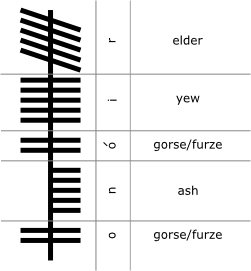
For some reason, I was struck tonight with an intense, irrational desire to get drunk and get a tattoo. I don't know why. Regardless, whenever the idea of a tattoo comes up, I generally lean toward getting something done in Ogham, which is an ancient Celtic script usually found carved onto standing monoliths and things. It's pretty simple stuff; lines of various lengths carved either orthogonal or oblique to some center stroke. In any case, I think it usually looks neat.

So, with that settled, I had to decide on a word. I picked the Irish word for "honor"/"respect" (onóir, pretty much pronounced the same), just because I felt like it. So, I looked that up in Ogham and drew up what it would look like (that's the picture posted below, read from bottom-to-top).


On basically a whim, I thought that would be nice on the inside of my right forearm (with the bottom near my elbow, up to the wrist), so I drew it on with magic marker to test it out for a bit. I could get used to it, especially if it was done by someone with any talent (i.e., not drawn by me with my left hand on my right arm).

Of course, I couldn't just leave it at that, so I did more research. Apparently, each letter in the Ogham alphabet was associated with a tree sacred to the druids (so sayeth the Internet) and each tree was associated with some sort of mystical/divinatory properties. So, here's a brief description.
  • gorse/furze (o) - A yellow, flowering shrub. Signifies finding that which is sought, abundant knowledge and blessings, and invokes a reminder to share of this bounty.
  • ash (n) - The tree, obviously. Associated with interconnectedness and a recognition that one's problems and questions are not his alone. Urges one to recognize the effects of his actions and to balance himself with the world.
  • gorse/furze (ó) - I just want to spell out the whole word.
  • yew (i) - An evergreen tree with poisonous berries, used to make bows and things. Heralds a coming change, or perhaps the recognition that nothing lasts forever and one should let go of the past.
  • elder (r) - A hearty, fast-growing shrub. Represents renewal and the cyclical nature of life, with change bringing newfound creativity.
Anyway, that's been my night.

Monday, October 30, 2006

aer lingus, erlang-us

First off, an update on the Ireland thing; I sent off an email to the course director at Trinity. Still no response, but hey...it's only been a couple of days (and despite the title of the post, it'll be a while before I'm buying plane tickets; it's only there for cleverness).

Secondly, in preparation for potentially becoming a distributed computed grad student, I've been learning Erlang. For those of you who don't care about clicking the link, Erlang is a language for distributed systems that has primitive support for concurrency and error recovery while still maintaining the benefits of a high-level, functional language. So far, I like it. It's been fun to learn a new syntax and I like the thought of something distributed (I mean, seriously; think about all the unused cycles in my apartment!). I'm planning on eventually writing some sort of digital ant farm; for now, I'm working on a simple hill-climber that will grow into a swarm algorithm of some sort.

Also, I've been on a wine kick lately; I might be posting about that from time to time in the near future.

Wednesday, October 11, 2006

the pipes, the pipes are calling

For those of you who may not already know, I have a plan. I tell the Internet my plan for two reasons: (1) I'm rather excited about the plan, and (2) if more people know about it, there's more pressure for me to follow through.

So, anyway, here's the plan: I'm going to apply for a master's degree in computer science at Trinity College, Dublin (Ireland, if that wasn't immediately obvious).

For those of you who know me only marginally or through certain circles, that may be a bit of a surprise; a foreign M. Sc. in networks and distributed systems is a far cry from a domestic Ph. D. in philosophy. When it comes right down to it, though, computer science is what I do. And if I can do it in Ireland, I am in like Friends was in the mid-to-late 90s.

Although I haven't worked out all the details, here's what I know about the plan so far:
  • My background in JDE seems to match well with the program (or should I say, programme), so I think my application would be well received,
  • Provided I get in, the course would last me from October 2007-September 2008 (or 2008/2009, pending discussions on fellowships),
  • I would end up with a M. Sc. in computer science from Trinity, and
  • It's in Ireland.
Overall, I see no real problems with this plan, so I'm going to do it. I'll give more details as I get them.

Thursday, October 05, 2006

potent potables

Apparently, one shouldn't leave containers of perishable liquid sitting around for multiple months without at least checking on them once in a while. I have two testimonials.

One: A jug of milk was left half-full in the office fridge for approximately 3 months. The milk had been slightly sour when purchased (thanks, SunMart!) and, of course, got progressively worse. However, no one was ever planning on drinking it, and no one really used the fridge for much, so it wasn't an issue...

...until the pressure building inside caused the bottom of the jug to rupture and leak mostly-curdled milk all over the inside of the fridge and onto the floor outside it (the office smelled like puke last Friday).

Two: My roommate purchased a bottle of mead from James Arthur Vineyards about six months ago (you'll have to correct me if that's wrong, Jesse) and placed in the wine rack, where it sat quite contentedly...

...until Tuesday, when some combination of a bad cork, oxygen in the bottle, and overactive yeast managed to spontaneously fire the cork across the living room. The bottle happily gurgled half of its contents onto the futon before we recovered enough from the shock to tip it upright (the futon mat still somewhat smells like vinegar).

Thursday, September 14, 2006

here there be dragons

Sometimes, I am far dorkier than I would usually care to admit (in this instance, "sometimes" actually means every hour of the day).

As an example, consider one of the (admittedly many) allegorical devices I use every day at work: dragons. I grew up with a rather fantasy-based imagination--King Arthur, Tolkien, plastic swords, Dragon Warrior on the NES, the Dragonlance series, etc.--so I suppose it's really no wonder that I've drawn that cognitive set with me to the present day, but the thing that gets me about it is that I've made it work so well (at least, as far as I'm concerned).

So, here's how the dragons work for me now. In the current setting, "dragons" refer to considerations or parts of the software that we have acknowledged but not yet dealt with. It can apply to both business risks (say, the terms of an NDA we haven't written yet) or parts of the design that have yet to be implemented (such as a stub function within a larger sequence). I even made a definition in my little task-list plugin in my IDE for "//HTBD" so I can denote places in the code that I have to come back to and finish.

In general, the reference comes from the practice of ancient cartographers drawing serpents or other mythological creatures at the edges of the known world (the title phrase of this post loosely comes from the Lenox Globe, ca. 1503). Those parts of the system that have yet to be defined are hence "off the edge of the map" and are thus "dragons".

In any case, it keeps me entertained at work. I always used to daydream about slaying dragons, and now I get to.

Wednesday, September 13, 2006

killing me sweetly

I think my job is going to kill me.

Not because of the stress, not because of the potentially long hours, but because of the adult-onset diabetes.

Granted, programming isn't the healthiest job in the world anyway; I stare at a computer monitor all day (eyes), type into a keyboard for hours (wrists), and sit at a desk doing very little in the way of exercise (heart). But what takes the cake in this case (ha!) is the sugar.

The office fridge is stocked with Pepsi, cream soda, etc. We've even made a little pop-can tetrahedron, which is currently starting into its eighth triangular layer; right now it's at 86 cans. Figuring most of those are Pepsi and only a couple are diet, I'd say we can look at an average of around 140 calories and about 38 grams of sugar. All told, that brings us close to 12,000 calories in the stack and about 3,200 grams of sugar consumed. Granted, it's not all me and it's taken us a few months, but still...that's a lot of high fructose corn syrup.

Maybe we should switch to diet.